
Introduction to Brief Solution-Focused Coaching
In a Brief Solution-Focused Coaching session, questions are designed to shift the client’s attention towards solutions.
Article written by: Peter Szabó, Solution Focused Coach and Trainer
Introduction to Brief Solution-Focused Coaching begins with the recognition that, in these times of astonishingly rapid change, coaching, like other services, must deliver a high level of performance and excellent results within a short period of time. This approach responds to that need by focusing on the client’s desired future, existing resources, and the small, practical steps that can generate meaningful and sustainable progress.
Coaching at Its Most Concise. Brief, Simple, Successful.
Coaching professionals seek to deliver results as quickly as possible. At the same time, the personal skills clients can develop through coaching are among the most highly valued in today’s business world. These observations give us sufficient reason to examine the effectiveness of the coaching process in greater depth. Which factors are decisive in achieving success in coaching sessions in the simplest possible way? Which assumptions help us reach our objectives as quickly as possible? Which actions should you avoid in order to maximise your effectiveness as a coach?
The answers to these questions offer valuable insights into Brief Solution-Focused Coaching as an engaging alternative to traditional problem-focused approaches.
Brief Solution-Focused Coaching

In Brief Solution-Focused Coaching, questions are designed to shift the client’s attention towards solutions. Instead of discussing problems, difficulties, and their causes, we explore with the client the goals they want to achieve, past exceptions that led to success – times when the problem was not present – the solutions that emerged once the goal was achieved, and the resources already available to them.
This method is particularly well suited to people working in business, as these clients are already familiar with many of the questions we ask – for example, questions about defining goals and vision, best practices, or business management expertise. What is unusual is the way the questions are asked, the surprising order in which they are introduced, and, most importantly, the truly distinctive step-by-step application of the Brief Solution-Focused Coaching method.
The Three Stages of Finding Solutions
In Brief Solution-Focused Coaching, questions are designed to shift the client’s attention towards solutions. Instead of discussing problems, difficulties, and their causes, we explore with the client the goals they want to achieve, past exceptions that led to success – times when the problem was not present – the changes that occurred once the goal was achieved, and the resources already available to them.
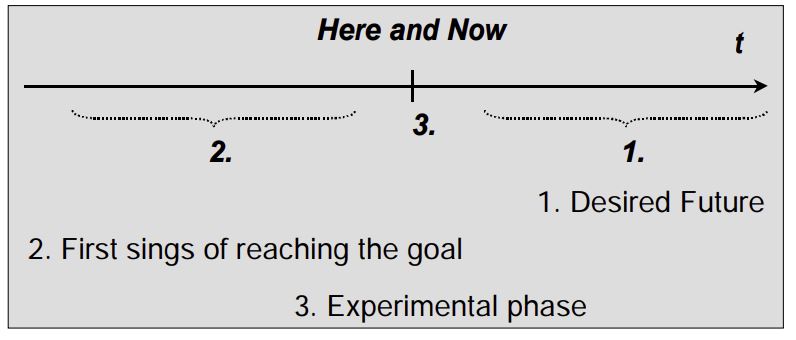
In the first stage, the client and coach discuss the desired future (see Figure 2) and the changes needed to reach it. This goal-setting stage is also found in other coaching approaches. However, in the Solution Focus approach, attention is centred on the point at which the goal has already been achieved. The client describes their vision of the future in the smallest detail. By contrast, no information about the problems is requested.
In the second stage, the client and coach discuss the recent past, exploring the first signs that change was already moving in the desired direction. At this stage, the coach asks only about what is already working. This helps the client identify possible next steps and highlights the resources already available.
In the third stage, the client sets the intention to apply what has been discussed so far. Usually, an experimental period is agreed upon, involving small changes in everyday activities. This stage is designed to keep the client’s attention focused on the solutions that are likely to work.
Identifying Solutions versus Solving Problems
In the culture we live in, it is considered normal to focus on problems and their causes, analysing and diagnosing them in order to find solutions. The Solution-Focused Coaching approach avoids the need for problem analysis. Instead of spending time understanding the problem in detail, the coaching session is used to learn as much as possible about goals, solutions, and resources. Once clients set aside the discussion of problems, they are often surprised to discover how much they have to say about solutions. It is as though this information was not available to them before and only emerges during the coaching session.
“No problem can be solved at the same level of thinking at which it was created.”
Albert Einstein
Solution-Focused Coaching avoids directing attention towards the problem. Instead, it supports the client in consciously shifting their focus towards solutions. A typical Miracle Question in this process is: “Suppose a miracle happened and your problem was resolved. What would you do then…?”
Avoiding questions that analyse the problem in detail offers many advantages, including:
- The coaching session is shorter; it is easier for the client to find the right solutions. The more extensively they talk about solutions that worked in the past and possible solutions for the future, the more aware they become of the choices available to them. The coach can support the client in recognising these available solutions so that they can access them in their everyday activities;
- The client’s confidence in their ability to find solutions increases. The more they discuss their resources and abilities, the more manageable the situation becomes, and the stronger their motivation to put the solutions into practice. After all, words create reality;
- In addition, a solution-focused awareness helps clients see themselves and act as experts. If the person seeking solutions is also capable of finding them, then the coach’s role is to help them identify the most suitable options, goals, resources, and solutions.
Further Explanations
Of course, such a paradigm shift may seem unfamiliar at first. It can challenge our experience of what we have previously regarded as logical and effective. The Solution-Focused approach emerged from extensive research into the question: “How does counselling work?” The findings show that focusing on solutions – and only on solutions – enables clients to achieve their goals in the shortest possible time, with outcomes that are just as effective as those produced by other methods. Further evidence has also emerged from various scientific fields, supporting these earlier findings and offering a clearer understanding of how the approach works.
Chaos Theory
Complex systems in a state of unstable equilibrium develop most effectively when they are self-regulating. The number and complexity of the influencing factors are so great that our linear, cause-and-effect view of reality reaches its limits. Why not set aside analysis and the focus on the causes that created the problems, and instead concentrate on identifying the small changes that can move us in the desired direction, while becoming more aware of the forces that support us?
Constructivism
If there is no objective reality and each of us constructs our own reality through subjective individual consciousness, would it not be better to support clients in creating the most helpful personal reality possible? The Miracle Question, for example, helps clients move beyond limiting, outdated ways of thinking and develop more creative ways of identifying the solutions available to them. The more “exceptions” the client discovers as signs that the miracle is already beginning to happen, the more confident they become in creating the right solutions.
Cybernetics
There has been extensive research into why the management of complex systems fails. It appears to be easier to prevent what we do not want from happening than to achieve what we do want. It is much more effective for the coach to redirect attention away from problems, which can otherwise prevent the client from finding suitable solutions.
Instead of repeating the same actions that we already know do not work – focusing on problems and thereby requiring even more effort – a focus on solutions creates space for new approaches by directing attention towards doing something different. Experience has shown that the results are positive. Even when solutions do not emerge immediately, this approach helps us take steps in the right direction.
Systems Theory
Any change occurring in one part of a system influences the future interactions of everyone involved. When clients begin to describe their goals, the solutions available to them, and how others may respond differently, their relationships with those around them begin to change. When clients focus on the solutions within a system and become aware of them, changes that benefit the system are easier to implement and sustain.
Communication Theory
As coaches, we are aware that we will never fully understand what our clients are trying to communicate. If our interpretation is inevitably subjective, why not assume that what the client says about solutions is valid? The coach should always keep in mind what the client identifies as useful and helpful. Research into different forms of counselling has shown that the most effective approach is appreciative and client-centred.
Practical Examples – Simple, but Not Easy
The Solution Focus Coaching method is simple, but it requires adopting the right attitude, especially when the session is challenging. In conclusion, I would like to offer a few examples from my experience as a coach specialising in the Solution Focus approach:
1
A close friend told me about an argument he had had with one of his colleagues. I was strongly tempted to discuss the problem and learn more about the circumstances and details of the conflict. My challenge was to awaken his interest in focusing on solutions and to ask, for example, what he believed should remain unchanged in his relationship with his colleague, or to help him decide what the best response might be.
I was unable to do either of these things. Because of our friendship, I felt his pain and sadness deeply. It was too difficult for me to approach the situation from a Solution-Focused perspective while also being a close friend.
2
One client had been subjected to intimidating behaviour. I was tempted to focus on the problem and work with her to resolve it. My challenge was to keep my attention on what would happen on the day after a “miracle” had occurred, helping her describe how confident she would feel and what she would do differently.
With each session, she gave me more and more examples of situations in which she had felt confident, even if only to some extent. This helped her rebuild her self-confidence. I must say that helping her identify and become aware of these examples was not easy. At first, because of the stress she had experienced, she responded to all my solution-focused questions with further information about the problem.
Nevertheless, over the course of five sessions, she was able to gather enough energy and motivation to apply for a new job. Until then, despite her exceptional professional qualifications, her attempts to find a new position had been unsuccessful because she appeared desperate and struggled in every interview.
3
An executive came to see me before a very important sales negotiation. He asked me to give him the most successful and foolproof strategy. It seemed that he wanted strictly professional advice. I had serious doubts about whether my coaching questions would have the desired effect.
I offered him a considerable number of suggestions, especially because his negotiation tactics seemed rather clumsy to me. Naturally, he ignored all my advice. As I began to panic, I asked him about his objectives for the negotiation. From there, we started to explore the factors that had contributed to his success in previous negotiations.
At last, our meeting began to become productive. We were able to identify, with accuracy and clarity, behavioural patterns that were both useful and appropriate for the situation at hand. By the end, the executive was able to approach the negotiation with greater confidence and a renewed sense of motivation.
He later told me that what had helped him most was that I had shown confidence in his abilities.
4
A quality assurance team wanted to improve its internal communication. They invited me to facilitate a two-day workshop on communication skills, and I prepared a large number of communication exercises that I had used in the past.
With some effort, I persuaded them to have only two or three two-hour meetings instead. At the first session, which took place during one of their regular team meetings, I introduced a progress scale. This tool helped the team members assess the current quality of their internal communication. They estimated that they were at 3.9 on a scale from 1 to 10.
They then described what they would be doing differently if they were at 4.9. At the end, I asked each of them to give me a confidential individual estimate of what they would do over the following two weeks, before our next meeting, and how they would assess their progress. I also invited them to notice and write down anything that was already happening and that would support their estimates.
Three weeks later, at our next meeting, I asked: “What has improved in our internal communication?”
They told me that they had noticed many improvements, even more than they had expected. They all agreed that the team was communicating better and that they would be able to sustain this improvement.
I completed my work with them in two sessions, without using any of the exercises I had originally planned.
5
A merger in the service sector: For two years, 300 employees had been dealing with the effects of the merger between the companies they belonged to. The differences between the two corporate cultures seemed so great that they might never be overcome.
One way of working in situations like this is to use boards and cards to highlight what the two cultures have in common. We took a considerable risk and suggested instead that they make a leap forward in time. We divided the 300 employees into small, mixed groups and asked them to imagine that two years had passed and that cooperation within the company had improved significantly.
This theoretical, solution-focused approach exceeded all our expectations. The participants communicated with one another in a way that had been almost unimaginable before making this leap forward in time. They were able to identify new and sustainable changes in their everyday work.
A follow-up meeting is planned to support them in recognising the progress they have made and exploring how they can sustain it.
For coaches, remaining solution-focused and client-centred requires considerable inner discipline. Nevertheless, it is a risk worth taking, because it helps clients find their own solutions in a remarkably short period of time. It also frees coaches from the burden of solving the problem, placing responsibility – together with trust – into the hands of the true expert: the client.
A Solution-Focused Conversation About Coaching: The First Session.
An experienced coach (C) has a Solution-Focused conversation with a coach attending a coaching training programme, who takes the role of the client (K). The questions asked by the coach reflect the usual structure of Brief Solution-Focused Coaching sessions. The client’s responses have not been reproduced in full.
Stage One = Expectations for the Future
C: What would need to happen here today for you to be able to say afterwards that this coaching session with me was worthwhile?
K: If I could access approaches, pathways, and methods that would help me become a better coach. If I could identify precisely what is important, so that I could focus only on the questions that are truly useful (…).
C: What would that look like for you?
K: I would be able to value what I do as a coach more if I could see my clients making real progress. Then I would know that I was doing things well.
C: And how would your clients know that you were doing things well?
K: They would achieve success more quickly. They would gain greater confidence in their ability to find solutions. And they would also have more options (…).
C: My next question may seem a little unusual. It requires some imagination to answer. Suppose you go home after our meeting, go to bed in the evening, and while you are asleep, a miracle happens. The miracle is that the reason you are here now has been resolved—just like that. But because you were asleep, you did not realise that a miracle had happened. How would you begin to discover the next day that a miracle had occurred and that you had achieved all your goals as a coach?
K: I have no idea… (long pause)… It would become clear to me after the session I have tomorrow. I would probably feel rested, calm, and confident that the coaching session would go well.
C: And how would your client know that a miracle had happened?
K: She would experience my welcome that morning as warm. (…) She would think that I looked different, that I was relaxed, that I trusted myself and, at the same time, was interested and curious to hear what she had to say.
C: How would you know that this client knew?
K: I think I would see her begin to relax. She might develop interesting new ideas and realise that her ideas were very good.
C: And what would you do then?
K: I would pay particular attention to solution-focused strategies and to the abilities the client already has (…). I think I would be able to let go of my own ideas about what might be easier for her to do.
Stage Two = Signs That the Goal Has Been Achieved
C: Looking back over the past few days, in which coaching situation did you feel similar to what you described about the morning after the miracle?
K: Last Thursday, just for a moment, I had a conversation in which I felt very good.
C: How did you manage to do that?
K: Two questions came to mind spontaneously, and they helped the client find her own way forward.
C: How did you know to ask those two particular questions?
K: The first question came easily. I asked her: “What would you like to achieve now?” I had already had positive experiences with this question, so it was almost an automatic impulse. The second question was different because she gave me the idea. She said: “I am sure my manager will not accept my ideas.” I asked her what she thought her manager would want. At that moment, everything fell into place. I do not remember exactly what she said because she began saying, “Oh, that is it!” Then she smiled and left.
C: What do you think you did that helped everything fall into place for her?
K: I did not feel the need to suggest what she should do. I simply listened carefully to her answers. She happens to be someone I respect and value, so I just trusted that she would find the solutions herself.
C: Good, wonderful. On a scale from 1 to 10, where 1 represents the point at which you first felt that you had certain qualities as a coach, and 10 represents the morning after the miracle, where would you place your current qualities as a coach on this scale?
K: I think around 4.
C: Good. Why do you think it is a 4?
K: I have improved my skills by not offering advice. I can listen carefully and pay attention to what the client has to say. I can also sometimes trust my ability to ask helpful questions spontaneously.
C: Wonderful. If we went back to the conversation you had last Thursday, where would you place yourself on the scale as a coach?
K: I think it was a 9.
C: How would you know that you had taken a step forward and reached level 5?
K: If I felt enthusiastic about tomorrow’s meeting and also calm and relaxed, I would feel that I was at 5.
C: On a scale from 1 to 10, how confident are you that tomorrow’s meeting will be successful?
K: 9.
A Solution-Focused Conversation About Coaching: The Second Session.
The Solution Focus approach for the second and subsequent sessions is to focus on the solutions and resources that have emerged in the meantime:
- What has improved? What else? What would others say?
- How did you manage to do that?
- How can you sustain this progress?
Fewer Coaching Sessions, Greater Success
A group of researchers working with the sociologists Steve de Shazer and Insoo Kim Berg in the United States investigated how counselling hours could be reduced dramatically while achieving greater success. Over a period of nearly 20 years, the team examined and identified what was genuinely useful in conversations between clients and counsellors, in order to help clients reach their goals successfully.
This research led to the development of Brief Solution-Focused Counselling, a simple process that enables effective and satisfying solutions to be identified quickly. In practical terms, this means that by avoiding counselling activities that are of limited value, the time invested in the process can be reduced to around three sessions, each lasting 50 minutes. This form of counselling proved both effective and satisfying, with follow-up studies conducted after 6 to 18 months reporting a success rate of 86%. The research brought about a quiet revolution in the world of therapy. The team has been working in Milwaukee, USA, since 1978 under the name Brief Family Therapy Center (BFTC).
Recommended reading:
”The Solutions Focus – the simple way to positive change”
by Paul Z Jackson and Mark McKergow Nicholas Brealey Publishing, London, 2002